
In buildings with stringent fire safety requirements,traditional fire doors often sacrifice natural light due to their heavy,enclosed design,leading to a cramped space and increased energy consumption for lighting.Glass-stainless steel fire doors,with their”Class A fire resistance+high light transmittance design,”maintain excellent lighting even within a 1.5-hour fire resistance period,making them an ideal choice for public buildings and commercial spaces.
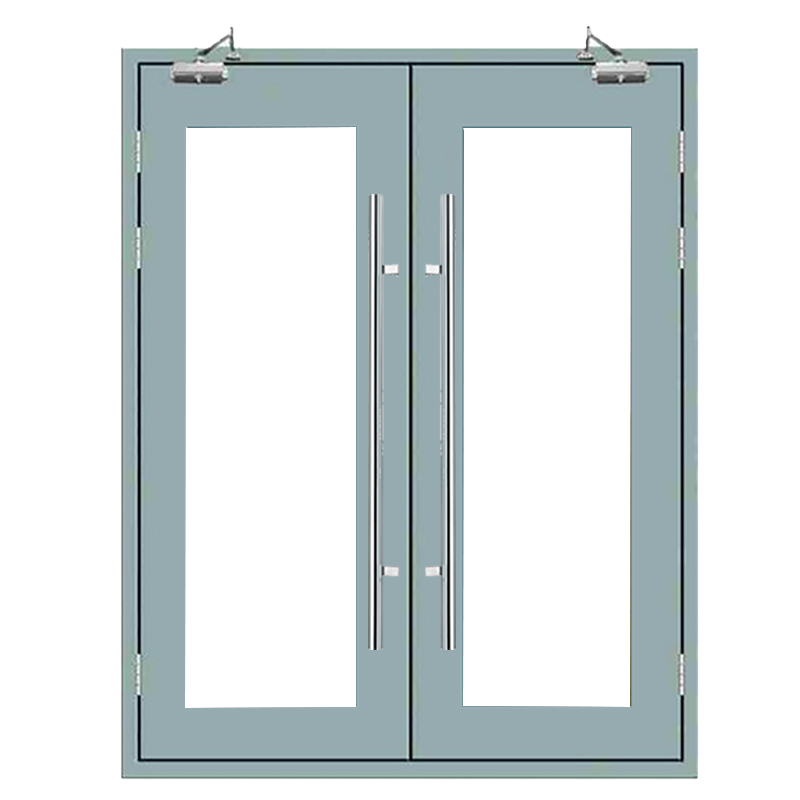
Class A Fire Resistance:Technology Supports Safety Standards
Glass-stainless steel fire doors strictly adhere to national standards,achieving Class A fire resistance through multiple layers of protection:
Tempered Fire-Resistant Glass:Employs a composite structure of single-layer tempered glass and a fire-resistant adhesive layer.In case of fire,the fire-resistant adhesive layer expands upon heating to form a heat insulation layer,blocking flames and high-temperature transmission for up to 1.5 hours.The temperature of the unexposed side does not exceed 140℃,ensuring the structural integrity of the door.
304 stainless steel frame:With low thermal conductivity,combined with internally filled fire-resistant expansion sealing strips,it expands 3-5 times in volume when heated,filling gaps in the door and effectively blocking smoke penetration.
Automatic closing mechanism:Equipped with a fire-resistant door closer and sequencer,the door automatically closes and locks in case of fire,preventing the spread of fire.
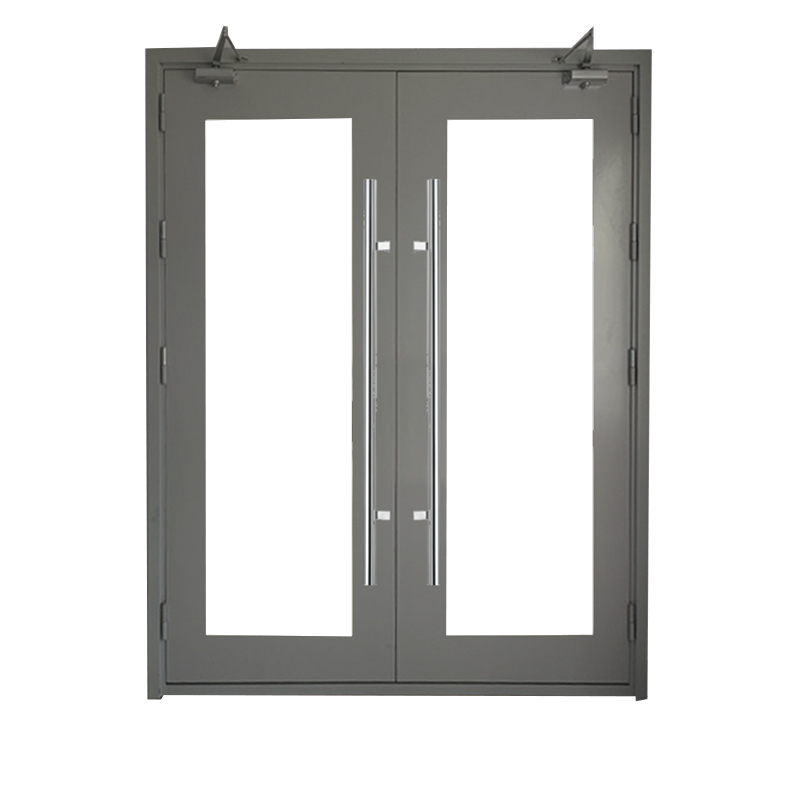
High Light Transmittance Design:Balancing Light and Safety
Traditional fire doors,due to their heavy materials,have a light transmittance of less than 30%.Glass-stainless steel fire doors,through optimized materials and processes,achieve a light transmittance of≥80%:
Ultra-clear Tempered Glass:Utilizing low-iron glass raw materials,with an iron content of less than 0.015%,light transmittance is increased by more than 10%compared to ordinary glass,resulting in higher color fidelity;
Narrow Frame Design:The 304 stainless steel frame is precision-machined,reducing the frame width to less than 50mm,minimizing visual obstruction and enhancing the sense of spaciousness;
Anti-glare Treatment:The glass surface undergoes a coating treatment,effectively reducing strong light reflection and preventing visual discomfort caused by differences in indoor and outdoor lighting.
Application Scenarios:From Public Spaces to Special Environments
Commercial Venues:Shopping mall atriums,pedestrian streets,and other areas require fire-resistant partitioning while maintaining unobstructed customer flow and visual continuity.
Medical Fields:Hospital corridors and examination rooms utilize fire-resistant glass doors to facilitate patient observation by medical staff and improve emergency response efficiency.
Transportation Hubs:Used in airport and subway station passageways and equipment rooms,balancing fire protection and traffic efficiency while reducing lighting energy consumption.
With its uncompromising Class A fire resistance and undiminished light transmission,fire-resistant glass doors redefine the balance between fire safety and spatial aesthetics,providing modern buildings with a more efficient and user-friendly fire protection solution.