
With increasingly stringent fire safety requirements,stainless steel fire doors,with their sealed combination of tempered fire-resistant glass and stainless steel frames,have become the preferred solution for balancing fire resistance and spatial transparency.This combination achieves a balance of fire resistance,heat insulation,sealing,and aesthetics through the synergy of material properties and process design.
Tempered Fire-Resistant Glass:A”Transparent Barrier”for Fire Resistance and Heat Insulation
Tempered fire-resistant glass is the core component of fire doors.Its structure is typically”single-layer tempered glass+fire-resistant adhesive layer”or”multi-layer composite glass.”In the event of a fire,the fire-resistant adhesive layer expands upon heating,forming an insulating layer that effectively blocks the transmission of flames and high temperatures.Experimental data shows that tempered fire-resistant glass conforming to GB15763.1 standards can maintain structural integrity for 1.5 hours,with the temperature of the unexposed surface not exceeding 140℃,meeting the fire resistance limit requirements of Class A fire doors.Simultaneously,the tempering process gives the glass surface compressive stress exceeding 90MPa,making its impact resistance 3-5 times that of ordinary glass.Even if it breaks,it forms small,blunt-angled particles,reducing the risk of personal injury.
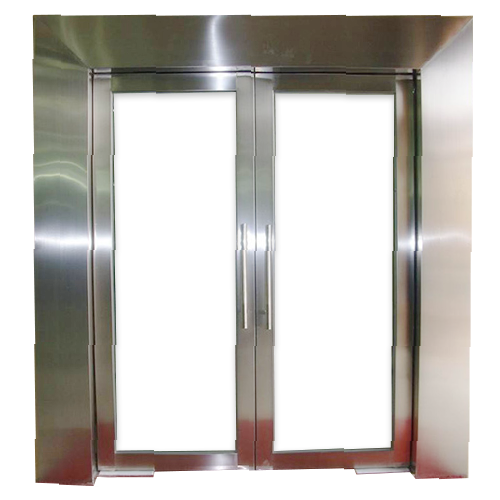
Stainless Steel Frame:Structural Support and Sealing Foundation
Stainless steel frames are made of 304 or 316 stainless steel,possessing characteristics such as corrosion resistance,high strength,and low thermal conductivity(only 1/3 that of carbon steel).The frame design typically employs a”thermal break structure,”using internal fire-resistant expansion sealing strips or insulation cotton to block heat transfer paths.For example,the overlap between the door frame and door leaf uses a stepped design,combined with fire-resistant silicone sealing strips,forming multiple lines of defense to effectively prevent smoke penetration.Furthermore,the surface of the stainless steel frame can be brushed,mirrored,etc.,to meet the decorative needs of different scenarios.
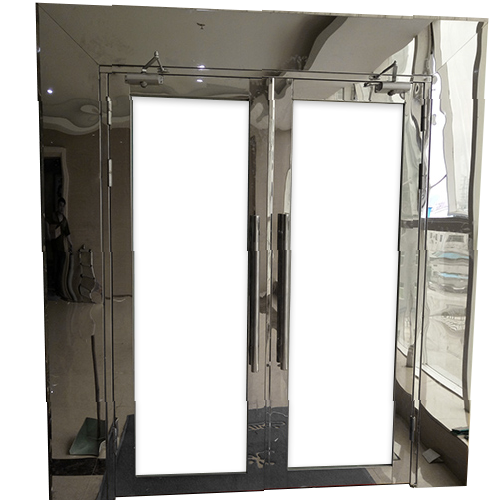
Sealing Assembly Process:Details Determine Performance
The sealing assembly of both components requires precision manufacturing:
Glass Embedding Process:Structural adhesive is used to fix the fireproof glass to the stainless steel frame.The adhesive layer thickness is controlled at 2-3mm to ensure bonding strength and fire resistance.
Gap Treatment:A 1-2mm expansion gap is left between the door leaf and the door frame,filled with fireproof expansion sealing strips.These strips expand 3-5 times in volume when heated,filling the gap.
Hardware Matching:Stainless steel fireproof hinges and door closers are selected to ensure the door can still open and close normally and automatically close under high temperatures.
This combination is widely used in shopping malls,hospitals,data centers,and other places.It meets the fire protection code requirements for fire compartmentation while maintaining spatial transparency through its transparent design,making it an ideal solution for fire safety in modern buildings.